You should know that I have a pretty poor body image of myself. I have struggled with overeating and being overweight for as long as I can remember, and it is still something that fills my thoughts most often during the day. Even in high school, when I was in reality quite trim, I saw myself as grotesquely fat.
For several years, I was involved in an unhealthy relationship with a girl that I almost married. Once, not long after I started college, I began to experiment with fasting. At the root of this was my own self-loathing; I ate too much, and saw the best solution as not eating at all. However, I was also deeply psychologically tied to this girl. Once, in a conversation about fasting, she told me, "I don't think you should do it; you are doing it for the wrong reasons." This simple declaration has haunted me since she said it.
The modern or contemporary evangelical understanding of fasting is pretty simplistic in nature: one fasts because it is a sign of devotion to God, that one has the faith to give up something as a show of faith. It is something that a person must want to do, or they shouldn't do it at all. Usually, fasting is associated with the liturgical observance of Lent; in my personal experience, I have met few evangelical Christians who regularly practice the spiritual discipline of fasting.
"I am giving up chocolate for Lent, because I believe in God."
"I am listening to only Christian music instead of secular music during Lent, because I want to be close to Jesus."
"I am giving up television."
The laundry list of New-Year's-resolution-style fasting commitments goes on and on.
So I've been doing some thinking, and I keep coming back to that same question that my ex-girlfriend provoked me to ask of myself almost five years ago:
What is the "right reason" to fast?
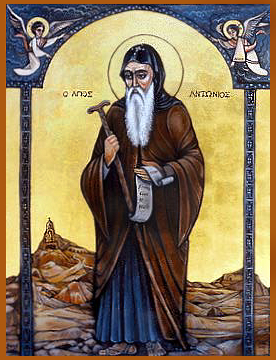
I've been taking a church history course at my seminary called "Sacred Journey," and last week we covered a small unit on early Christian monasticism. In contrast to the modern evangelical understanding of why we fast, ancient desert monks saw fasting as a form of self-denial; something that they didn't necessarily want to do, but that they recognized they
must do. Ancient monks believed—in contrast to so many Christians today—that all sin stems from hunger, physical or otherwise (This contradicts Augustine's assertion that human sin originates with human sexual lust). The temptation of the stomach is at its core what makes us human and what also draws us into overconsumption (America, anyone?) and excessiveness. Of course, monks did all kinds of crazy things to themselves. It was said of Abba Agathon that for three years he carried stones in his mouth until he learned to be silent.
Fasting reminds us that one of the greatest fruits of the Spirit—self-control—is the fruit that is not eaten.
I have seen this illustrated in the life and teachings of the Mahatma Gandhi. In his autobiography,
The Story of My Experiments with Truth, Gandhi writes at length about the relationship between food and the spiritual life, and confesses his own struggles with indulgence. He writes:
"
Passion in man is generally co-existent with a hankering after the pleasures of the palate...I have considered myself to be a heavy eater. What friends have thought to be my restraint has never appeared to me in that light...I began with a fruit diet, but from the standpoint of restraint I did not find much to choose between a fruit diet and a diet of food grains. I observed that the same indulgence of taste was possible with the former as with the latter, and even more, when one got accustomed to it. I therefore came to attach greater importance to fasting or having only one meal a day on holidays. And if there was some occasion for penance or the like, I gladly utilized it too for the purpose of fasting. But I also saw that, the body now being drained more effectively, the food yielded greater relish and the appetite grew keener. It dawned upon me that fasting could be made as powerful a weapon of indulgence as of restraint." (pp. 320-21)
So I am coming to find that my own misguided journey hasn't been so misguided, after all. My conversation with my ex should serve as a warning that we must be careful of what we choose to say to one another, as we never know the spiritual consequences of our own words. Though it has been an exciting adventure to rediscover fasting as of late, there were several painful years of being caught in the uncomfortable position of thinking that I was not good enough or that I did not have the right mindset for fasting, paired with my discomfort at my own excessive behavior. I overate, but couldn't fast to correct myself.
I recently learned that the word "prodigal" is a synonym for indulgence. When we refer to someone as prodigal today, we usually mean it with the connotation that the person has been gone for a while and has returned; this is, after all, the plot of Jesus's famous parable. But prodigality—excessiveness—was the sin of the younger son and the primary motivator in the story plot. The great humility of the son that prompted him to return home resulted from his own "forced fasting," which was a consequence of his extravagant living. Why do we not remember this?
I am learning more and more that fasting is indeed the answer to excessiveness, rather than conviction of excessiveness being the reason not to fast. My own hunger disgusts me, and fasting is a way of combatting that self-disgust, laying aside my preoccupation with what I will eat and what I look like, and spending time focusing instead my relationship with the Divine.
I now begin my own little "experiment with truth." And I am able to do so with a freed conscience.