

This week, a friend of mine who is
an Episcopal priest in Scranton, Pennsylvania, reported on his Facebook page
that a group known as the Pennsylvania Pastors Network has recently been making
automated phone calls to voters all over the state, urging them to “vote
biblically” in the upcoming Presidential election. The implied message of this
request was that true Christian discernment would ultimately lead to a
conservative vote for Republican candidate Mitt Romney. Putting aside the fact
that democracy and voting (as we know it) exists nowhere in the Bible, as well
as the irony of conservative Christians pleading with voters to elect a Mormon,
I am puzzled by what the PPN could actually mean by their appeal. As a
Christian myself, my personal ethics are based upon the teachings of Jesus and
the religious and social tradition offered by the Hebrew Bible. I am
particularly concerned by how our nation treats the poor, as well as the manner
in which we carry out social, economic, and punitive justice. The question,
“How would Jesus vote?” has become worthy of serious consideration in this
election. I am unsure of which Bible the PPN may be referring to, but the Bible
I read offers little help when it comes to choosing the President of the United
States, in part because the ethical demands of scripture go far beyond that
which any political candidate may be willing or able to fulfill as a holder of
public office. When seriously weighing the ethical options of my role in the
democratic process, I appear to be faced with four major options of how to use
(or not use) my vote in the upcoming election. I will attempt to list each of
these options below, briefly offering the benefits and drawbacks of each option
(when applicable) to better elucidate why I consider participating in the
upcoming election to be a particularly difficult moral decision.
1) Vote for the Republican candidate, Mitt Romney.
This is my least likely option. So many of my conservative friends who are voting for Romney in this election are doing so almost explicitly because Romney is not Obama. I do not feel that this is a viable way of ethical decision-making, nor is it a wise method for voting potential leaders into office. Additionally, I have tremendous misgivings about the federal budget plan proposed by Romney’s running mate, Paul Ryan. I share nothing in common with Ryan’s Randian political philosophy, as I believe in the ethical teachings of Jesus which find their power within philosophical and theological understandings of altruism—that is, against Ayn Rand’s objectivism, I find serious concern for one’s neighbor to be the ultimate deciding factor in how I make moral choices, whether this involves grocery shopping for myself or cooking meals for the homeless. The Romney/Ryan budget would cut SNAPS (“food stamps”) benefits by $133 billion, making it more difficult for struggling families to attain basic necessities. Also under the proposed Romney/Ryan budget, Pell Grant subsidies would be drastically cut, which means that many students from lower-income families would be unable to pursue higher education. I see no semblance of divine justice (in the Jesus sense of the word) in this option.
This is my least likely option. So many of my conservative friends who are voting for Romney in this election are doing so almost explicitly because Romney is not Obama. I do not feel that this is a viable way of ethical decision-making, nor is it a wise method for voting potential leaders into office. Additionally, I have tremendous misgivings about the federal budget plan proposed by Romney’s running mate, Paul Ryan. I share nothing in common with Ryan’s Randian political philosophy, as I believe in the ethical teachings of Jesus which find their power within philosophical and theological understandings of altruism—that is, against Ayn Rand’s objectivism, I find serious concern for one’s neighbor to be the ultimate deciding factor in how I make moral choices, whether this involves grocery shopping for myself or cooking meals for the homeless. The Romney/Ryan budget would cut SNAPS (“food stamps”) benefits by $133 billion, making it more difficult for struggling families to attain basic necessities. Also under the proposed Romney/Ryan budget, Pell Grant subsidies would be drastically cut, which means that many students from lower-income families would be unable to pursue higher education. I see no semblance of divine justice (in the Jesus sense of the word) in this option.
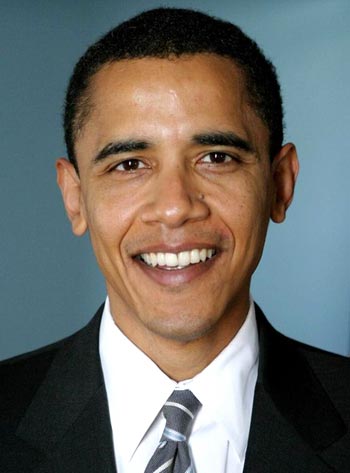
2) Vote for the incumbent Democratic
President, Barack Obama.
The
sitting President has instituted programs that have increased job growth and contributed
greatly to social spending programs that have raised the quality of life for
many low-income Americans. Additionally, Obama has passed the Patient
Protection and Affordable Care Act, which has extended health care benefits to
millions of Americans (including myself) who would have otherwise been unable
to afford even the most basic healthcare for themselves.
Yet under Barack
Obama, our national debt has grown by more than $5.3 trillion dollars, our
violent political conflicts have expanded to include at least three other
countries in which we have yet to officially declare war, gun rights have been
extended to allow concealed weapons in public places such as national parks,
nothing has been done to lower the gluttonous defense budget (which currently
accounts for roughly 60% of all federal discretionary spending, and has doubled
since 2001), and counter-terrorism drone strikes—what the Department of Defense
refers to as “pre-emptive defense,” if such a thing exists—have quadrupled
under Obama since the Bush administration, possibly killing hundreds of
civilians in the process. My conviction as a Christian will not allow me to
vote for a national leader who allows such violent attacks to persist.
Furthermore, while I am tempted to vote for Obama because he appears to me to
be the “lesser of two evils” in this election, it should be pointed out that if
it is irresponsible to vote for Romney because Romney is not Obama, then it is equally irresponsible to vote for Obama
merely because Obama is not Romney.
Voting for the lesser of two evils is—in my estimation—still a vote for an
evil.
3) Vote for a third-party
candidate.
A
few days ago I took an online poll that paired my political beliefs with those
of 2012 Presidential candidates, including lesser-known third-party candidates,
based upon statements made by each of the contenders for this year’s election.
I was surprised to find that I held most of my views in common with Green Party
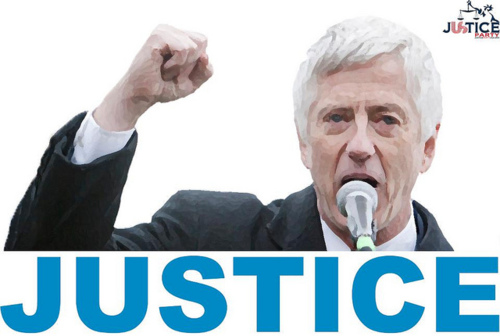
candidate Jill Stein, followed closely by Rocky Anderson of the Justice Party.
Anderson’s appearance was no surprise—I have been following the development of
the Justice Party for some time now, and have found that my personal ethics and
political values line up with this group quite nicely.
Voting
for a third-party candidate would allow me to vote for the person whom I feel
is best suited to lead our country according to my personal value system—that
is, voting for Stein or Anderson (who is only a write-in candidate in my state)
would give me the opportunity to “vote my conscience.” However, there is no
possible chance of a third-party candidate actually winning a U.S. election.
Voting my conscience, while taking a personal stand, would be a merely symbolic
action, since choosing to cast my ballot for neither the Democratic nor
Republican candidate would be largely ineffective for the actual election. In
essence, a third-party candidate vote is a vote for the ultimate winner of the
election—for better or worse.
4) Do not vote.
Emma
Goldman supposedly once famously said, “If voting changed anything, they’d make
it illegal.” Most U.S citizens, however, would reject this position. Yet
Christians have a powerful history of non-participation in the democratic
voting process for moral purposes. Dorothy Day is perhaps the greatest American
witness to non-voting as a matter of Christian conscience; though she once participated
in a hunger strike and picketed the White House in support of women’s suffrage,
Day herself never voted. With Peter Maurin and the Catholic Worker Movement,
she became a catalyst for change without ever casting a ballot, proving that
positive moral influence can indeed come from Christian non-participation in
the political system.

The argument might
be made that regardless of who wins this election, either of the two principal
candidates will make use of drone warfare, that both have spent a criminally
disproportionate amount of money relative to the average citizen’s paycheck on their campaigns while many in our nation starve, and that voting for a third-party candidate
would essentially be casting a vote for the ultimate winner of the election.
The logical final choice, therefore, would be nonparticipation. After all, when
the Israelites petitioned Samuel and Yahweh for a king so that they could be
“like other nations” (1 Samuel 8), the response from God is that God wants to be our authority. And Peter, when cornered by
the High Priest of Israel in Acts 5:29 for his participation in teaching the
crowds the good news about Jesus, responds, “We must obey God rather than human authority.” Perhaps the most
viable political option for Christians is the non-political one. Rather than
participation in the system that has alienated and disenfranchised so many of
our poorest citizens, perhaps Christians should instead be instigators,
following in the footsteps of Jesus by using our political imaginations to
circumvent authority and continue the subversive work of Christ.
Yet even this
stance is unsatisfactory. If casting a ballot for a third-party candidate is
“wasting” the vote, is nonparticipation not just as equally wasteful? While I
do not necessarily agree with those who would assert that if you don’t vote,
you have no right to complain, I still
cannot bring myself to disregard the fact that the right to vote (especially
for minorities and women) is a hard-won privilege, and that while many are
indeed crushed by the gears and cogs of the political machine, many more still
have benefited from much-needed aid dispensed by that very machine.
Conclusion
Is
the lesser of two evils, as Joseph Fletcher once suggested, ultimately the
good? I don’t think so. Being forced to choose between two candidates, neither
of whose policies appears to me to be ethically compatible with the teachings of Jesus, does not seem like a decision that offers freedom. If I cast a vote for one of the primary candidates,
they win and proceed to further engage the United States in violent military
conflict with other nations or irresponsibly manage our federal budget, I will
feel responsible for that action. Yet if I do not vote, or cast my vote for a
third-party candidate, I am denying myself the opportunity to have my vote make
a difference. Am I giving too much weight to one vote,
overestimating the power of a single citizen’s opinions and convictions?
Perhaps. But it remains a difficult ethical decision for me, and the election
is coming up soon. One way or another, I will be making a choice of utmost moral concern.


