Showing posts with label Christian ethics. Show all posts

Friday, November 2, 2012

Red, Blue, or Purple? Voting the Christian Conscience: A Case of Moral Perplexity


This week, a friend of mine who is an Episcopal priest in Scranton, Pennsylvania, reported on his Facebook page that a group known as the Pennsylvania Pastors Network has recently been making automated phone calls to voters all over the state, urging them to “vote biblically” in the upcoming Presidential election. The implied message of this request was that true Christian discernment would ultimately lead to a conservative vote for Republican candidate Mitt Romney. Putting aside the fact that democracy and voting (as we know it) exists nowhere in the Bible, as well as the irony of conservative Christians pleading with voters to elect a Mormon, I am puzzled by what the PPN could actually mean by their appeal. As a Christian myself, my personal ethics are based upon the teachings of Jesus and the religious and social tradition offered by the Hebrew Bible. I am particularly concerned by how our nation treats the poor, as well as the manner in which we carry out social, economic, and punitive justice. The question, “How would Jesus vote?” has become worthy of serious consideration in this election. I am unsure of which Bible the PPN may be referring to, but the Bible I read offers little help when it comes to choosing the President of the United States, in part because the ethical demands of scripture go far beyond that which any political candidate may be willing or able to fulfill as a holder of public office. When seriously weighing the ethical options of my role in the democratic process, I appear to be faced with four major options of how to use (or not use) my vote in the upcoming election. I will attempt to list each of these options below, briefly offering the benefits and drawbacks of each option (when applicable) to better elucidate why I consider participating in the upcoming election to be a particularly difficult moral decision.

1) Vote for the Republican candidate, Mitt Romney.
            This is my least likely option. So many of my conservative friends who are voting for Romney in this election are doing so almost explicitly because Romney is not Obama
. I do not feel that this is a viable way of ethical decision-making, nor is it a wise method for voting potential leaders into office. Additionally, I have tremendous misgivings about the federal budget plan proposed by Romney’s running mate, Paul Ryan. I share nothing in common with Ryan’s Randian political philosophy, as I believe in the ethical teachings of Jesus which find their power within philosophical and theological understandings of altruism—that is, against Ayn Rand’s objectivism, I find serious concern for one’s neighbor to be the ultimate deciding factor in how I make moral choices, whether this involves grocery shopping for myself or cooking meals for the homeless. The Romney/Ryan budget would cut SNAPS (“food stamps”) benefits by $133 billion, making it more difficult for struggling families to attain basic necessities. Also under the proposed Romney/Ryan budget, Pell Grant subsidies would be drastically cut, which means that many students from lower-income families would be unable to pursue higher education. I see no semblance of divine justice (in the Jesus sense of the word) in this option.

2) Vote for the incumbent Democratic President, Barack Obama.
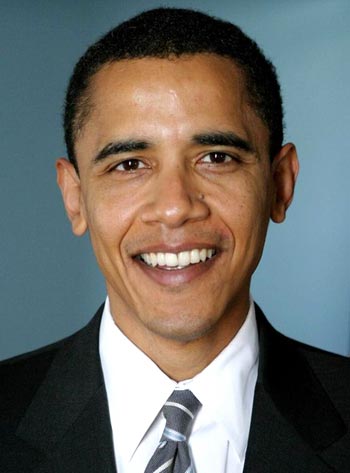
            The sitting President has instituted programs that have increased job growth and contributed greatly to social spending programs that have raised the quality of life for many low-income Americans. Additionally, Obama has passed the Patient Protection and Affordable Care Act, which has extended health care benefits to millions of Americans (including myself) who would have otherwise been unable to afford even the most basic healthcare for themselves.
Yet under Barack Obama, our national debt has grown by more than $5.3 trillion dollars, our violent political conflicts have expanded to include at least three other countries in which we have yet to officially declare war, gun rights have been extended to allow concealed weapons in public places such as national parks, nothing has been done to lower the gluttonous defense budget (which currently accounts for roughly 60% of all federal discretionary spending, and has doubled since 2001), and counter-terrorism drone strikes—what the Department of Defense refers to as “pre-emptive defense,” if such a thing exists—have quadrupled under Obama since the Bush administration, possibly killing hundreds of civilians in the process. My conviction as a Christian will not allow me to vote for a national leader who allows such violent attacks to persist. Furthermore, while I am tempted to vote for Obama because he appears to me to be the “lesser of two evils” in this election, it should be pointed out that if it is irresponsible to vote for Romney because Romney is not Obama, then it is equally irresponsible to vote for Obama merely because Obama is not Romney. Voting for the lesser of two evils is—in my estimation—still a vote for an evil.

3) Vote for a third-party candidate.
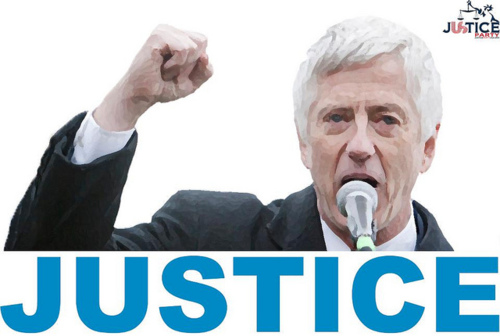
            A few days ago I took an online poll that paired my political beliefs with those of 2012 Presidential candidates, including lesser-known third-party candidates, based upon statements made by each of the contenders for this year’s election. I was surprised to find that I held most of my views in common with Green Party candidate Jill Stein, followed closely by Rocky Anderson of the Justice Party. Anderson’s appearance was no surprise—I have been following the development of the Justice Party for some time now, and have found that my personal ethics and political values line up with this group quite nicely.
            Voting for a third-party candidate would allow me to vote for the person whom I feel is best suited to lead our country according to my personal value system—that is, voting for Stein or Anderson (who is only a write-in candidate in my state) would give me the opportunity to “vote my conscience.” However, there is no possible chance of a third-party candidate actually winning a U.S. election. Voting my conscience, while taking a personal stand, would be a merely symbolic action, since choosing to cast my ballot for neither the Democratic nor Republican candidate would be largely ineffective for the actual election. In essence, a third-party candidate vote is a vote for the ultimate winner of the election—for better or worse. 

4) Do not vote.
            Emma Goldman supposedly once famously said, “If voting changed anything, they’d make it illegal.” Most U.S citizens, however, would reject this position. Yet Christians have a powerful history of non-participation in the democratic voting process for moral purposes. Dorothy Day is perhaps the greatest American witness to non-voting as a matter of Christian conscience; though she once participated in a hunger strike and picketed the White House in support of women’s suffrage, Day herself never voted. With Peter Maurin and the Catholic Worker Movement, she became a catalyst for change without ever casting a ballot, proving that positive moral influence can indeed come from Christian non-participation in the political system.
The argument might be made that regardless of who wins this election, either of the two principal candidates will make use of drone warfare, that both have spent a criminally disproportionate amount of money relative to the average citizen’s paycheck on their campaigns while many in our nation starve, and that voting for a third-party candidate would essentially be casting a vote for the ultimate winner of the election. The logical final choice, therefore, would be nonparticipation. After all, when the Israelites petitioned Samuel and Yahweh for a king so that they could be “like other nations” (1 Samuel 8), the response from God is that God wants to be our authority. And Peter, when cornered by the High Priest of Israel in Acts 5:29 for his participation in teaching the crowds the good news about Jesus, responds, “We must obey God rather than human authority.” Perhaps the most viable political option for Christians is the non-political one. Rather than participation in the system that has alienated and disenfranchised so many of our poorest citizens, perhaps Christians should instead be instigators, following in the footsteps of Jesus by using our political imaginations to circumvent authority and continue the subversive work of Christ.
Yet even this stance is unsatisfactory. If casting a ballot for a third-party candidate is “wasting” the vote, is nonparticipation not just as equally wasteful? While I do not necessarily agree with those who would assert that if you don’t vote, you have no right to complain, I still cannot bring myself to disregard the fact that the right to vote (especially for minorities and women) is a hard-won privilege, and that while many are indeed crushed by the gears and cogs of the political machine, many more still have benefited from much-needed aid dispensed by that very machine. 

Conclusion
            Is the lesser of two evils, as Joseph Fletcher once suggested, ultimately the good? I don’t think so. Being forced to choose between two candidates, neither of whose policies appears to me to be ethically compatible with the teachings of Jesus, does not seem like a decision that offers freedom. If I cast a vote for one of the primary candidates, they win and proceed to further engage the United States in violent military conflict with other nations or irresponsibly manage our federal budget, I will feel responsible for that action. Yet if I do not vote, or cast my vote for a third-party candidate, I am denying myself the opportunity to have my vote make a difference. Am I giving too much weight to one vote, overestimating the power of a single citizen’s opinions and convictions? Perhaps. But it remains a difficult ethical decision for me, and the election is coming up soon. One way or another, I will be making a choice of utmost moral concern.

Thursday, June 28, 2012

Christian Against Universal Healthcare? No Such Thing.

For a much more eloquent and well-researched article on this subject, please see this recent article posted by my friend and New Testament professor, Dr. David May.
*****
"What Would Jesus Do?" is probably the most useful phrase to come out of the contemporary Christian movement of the last several decades. Since first appearing among Christian youth groups in the early 1990s, WWJD? has become almost as ubiquitous as "John 3:16," showing up on billboards, church signs, and the shirtless chests of body-painted, rainbow-wigged sports fans. Now that the Affordable Care Act (pejoratively known as "ObamaCare") has been ruled perfectly legal by the Supreme Court, it seems that we must take WWJD? more seriously than ever: when it comes to government policies which attempt to make healthcare affordable to families that would otherwise have no way of receiving medical treatment, we must either support these policies in any way we can, or we must cease to define ourselves as Christians.
St. Francis comforts a man with a pre-existing condition.

Please bear in mind that what follows is not an arguement from a medical perspective, from a capitalist perspective, from a political/Constitutional perspective, from a legal perspective, or even from an American perspective. The point of this post is not to show you that many other developed (and developing) countries have had universal healthcare plans for years. I argue this strictly from the perspective of a Christian with an ethical obligation to love and serve my brothers and sisters. And you can feel free to disagree with me—but (you will rarely ever hear me say this so matter-of-factly) you'd be wrong. Wrong.

There are few circumstances for which this argument is either called-for or efficacious—but the debate over healthcare is, I think, one of those circumstances. 

Christians who oppose affordable health care do so without a leg to stand on, ethically speaking. Without some extreme hermeneutical gymnastics, it is nearly impossible to answer the question "What would Jesus do?" with "Deny millions of Americans the ability to afford to have their illnesses treated." After all, Jesus was a healer. But perhaps more importantly, Jesus was also an ethicist, and if we are to seriously consider using the Nazarene as a model of ethical Christian behavior, we must consider the implications of some of his  teachings.
  • Matthew 25 tells the parable of the separation of the sheep and the goats, in which the animals are judged according to how they treated the poor, the sick, the hungry, the thirsty, and the imprisoned. As they find out later, those who helped the people mentioned above were actually giving aid to Jesus—the implication being that we are to treat the less-fortunate as though they were Christ himself. If we deny affordable healthcare coverage to the types of people mentioned above, we are effectively denying them to Jesus.
  • The very foundation of Christian doctrine lies in the notion of self-sacrifice for the benefit of our neighbors, regardless of the personal cost to us, and regardless of whether or not we believe they deserve it. As he was nailed to the cross and executed by the Romans, Jesus uttered the prayer, "Father, forgive them, they do not know what they are doing."
  • The fundamental debate over U.S. healthcare reform is in reality directly related with your individual perception of the poorest among us. I have seen families ruined by outrageous and unjust medical bills and lack of access to affordable care. I've seen brothers and sisters that have had to drop out of college to help care for their injured and ill siblings because their family could not afford long-term healthcare and education. But Jesus showed unwavering solidarity with the poor. Jesus said, "Blessed are you who are poor, for the Kingdom of God belongs to you." Jesus said, "The spirit of the Lord is upon me, because he has anointed me to bring good news to the poor, to proclaim release of captives and recovery of sight to the blind..." Jesus said, "Go, sell what you own, give to the poor, and follow me." Jesus said "When you give a banquet, invite the poor, the crippled, the lame, and the blind. And you will be blessed, because they cannot repay you." It does not matter if you believe that the poor are lazy moochers who are only looking for a handout, the point is they are poor, and Christ commanded his followers to serve them. End of story.
  • And, in case your concern is that the government is telling you what to do with your money, see Luke 20:25 ("Give to Caesar what is Caesar's") and Luke 6:30 ("Give to everyone who asks of you"). Unless you're willing to go all "Peter and John" on a sick person and say, "Silver and gold have I none, but such as I have give I thee..." and heal the person then and there, it looks like you're going to have to show your support monetarily.

At this point, it matters little in what form universal health care materializes: whether it is through the government, like the Affordable Care Act, or through a church or other nonprofit organization. The important part is that it becomes the standard by which we can measure the care of our nation for its citizens. As someone who has been a vehement advocate of the egalitarian and peaceful Kingdom of God, I am by no means a fan of government when it gets in the way of personal spiritual liberty and freedom of the soul. BUT: if it is indeed absolutely necessary to have a governing body, should health care not be one of the primary reasons for the existence of such an institution? After all, it states in the Preamble to our United States Constitution that "We the People" established the document to help (among other things) "promote the general welfare" of the public. If we are to continue to call ourselves followers of Jesus we must come to terms with the fact according to his teachings, we have a moral obligation to ensure a higher quality of life for our neighbors. And if we can't bring ourselves to part with our own possessions to accomplish that goal, then we need to stop referring to ourselves as Christians.

What would Jesus do? Most likely, he would stop whining about paying taxes and pursue the cause which seeks to do the greatest good for the greatest number of people, regardless of power, politics, and money. So you may argue the finer details of this debate—it is, after all, a much more complicated discussion than what time and space have permitted me to write about here—but in the end, for the Christian, it ultimately falls to the simple decision of whether or not we are loving our neighbors with our actions. If your argument is more about splitting hairs than about showing love, you are wrong. Wrong.

Friday, April 6, 2012

Good Friday: Witness to an Execution

He who hung the earth upon the waters : today he is hung upon the cross.
Common Prayer, from the litany for Good Friday

Remember Troy Davis?

Perhaps not, with all of the news lately about Trayvon Martin. The media has a way of creating a feeding frenzy on one issue before losing interest and moving on to something else. Let me refresh your memory: Davis was a man from Savannah, Georgia, who was convicted of the 1989 slaying of a police officer. After 20 years on death row, and against both mounting evidence of his innocence and massive public outcry, Davis was put to death by lethal injection by the Georgia State Corrections Department in September. Near the end, support for Troy became an international phenomenon, drawing pleas from Desmond Tutu, Jimmy Carter, and even Pope Benedict XVI to halt the political gears of death. The entire world watched eagerly to see just what America would do. And we used that spotlight to spread a message of violence and inhumanity: we are in the business of denying clemency.

It is ironic, I think, that a nation—an empire, even—whose government clings so fiercely to the faith of an executed rabbi does not recognize the injustice of condemning others to death. A religion borne out of a political killing eventually became the unofficial religion of a country which seemingly takes delight at the mere thought of carrying out political killings. Texas Governor Rick Perry, who operated his presidential candidacy on a Christian base, was even applauded at a September 2011 political debate because of the record-breaking number of executions that have been carried out under his watch:


We like putting people to death so much, in fact, that a recent study ranks the United States fifth in the entire world when it comes to execution numbers. As in, fifth out of over two hundred other countries. Fifth place. Right behind Iraq, Iran, Saudi Arabia, China.

And here we are this morning, eating breakfast and drinking tea to observe the day that Jesus was nailed to a Roman cross as an insurrectionist (and tax evader?) and died as a martyr. What is wrong with us?

The only way that our rituals and traditions—even our religion as a whole—can possibly be of any use to humanity is if through them we somehow learn to love more, to forgive others, to gain an understanding of solidarity with the marginalized and oppressed. If Jesus's death means anything to us at all, it should help us realize more fully that the Reign of God is not like the empires of this world, and give us the fortitude to resist a culture of death by clinging to the hope of new life in the here-and-now. The Church is not a vehicle of Empire, and Empire is not the deputy of the Church. In fact, we are adversaries. When the Empire of this world says "condemn," the Church is (or should be) there to say "forgive."

Not long after Troy Davis's last day on earth, a transcript of his final words was made public by the Georgia Department of Corrections. There are echoes of the Jesus Way in his words:
Well, first of all I'd like to address the MacPhail family. I'd like to let you all know that despite the situation—I know all of you still are convinced that I'm the person that killed your father, your son and your brother, but I am innocent. The incidents that happened that night was not my fault. I did not have a gun that night. I did not shoot your family member. 
But I am so sorry for your loss. I really am—sincerely. 
All that I can ask is that each of you look deeper into this case, so that you really will finally see the truth. 
I ask to my family and friends that you all continue to pray, that you all continue to forgive. Continue to fight this fight.
For those about to take my life, may God have mercy on all of your souls. God bless you all.
Amen, Troy Davis. Amen.

Wednesday, September 21, 2011

A Brief Polemic Against a Bumper Sticker Faith

Beware the bumper sticker faith, my brothers and sisters.

You know what I'm talking about. There are lots of different types: those who prefer icthus fishes to express their faith for them (and those who go one step further, in case anyone didn't get the picture), and those who prefer hellfire and damnation stickers; there are those who choose cutesie stickers with theologically shallow messages, those who prefer theological stickers with thinly veiled political agendas, those who prefer political stickers with thinly veiled theological agendas, and then there are those of us that just prefer stickers, period:

(This is my own truck, by the way)

I say again: beware of this, my friends.

Admittedly, I am just as guilty of this as any. And it's pretty easy to see how others derive satisfaction from the lazy activism that bumper stickers afford. I enjoy waiting at the millions of stoplights on the main highway that runs through my town, watching in my rear-view mirror the expressions of unsuspecting drivers who pull up behind me as they read the stickers that plaster the backglass of my camper shell. These looks are extremely gratifying, ranging anywhere from, "Ugh. He's a Christian with a big mouth," to "Hooray! He must be a liberal!" to "What the hell does that even mean?"

But we must realize that a bumper sticker faith—like a faith that relies on so-called "contemporary worship" songs to emotionally stir the person singing them—often says more about the person who shows them off than it does about the causes they represent. Telling the world that you are against abortion or the death penalty is the bumper sticker equivalent of bragging to your entire congregation, "I could sing of Your love forever!"

When we begin to let our catchy slogans speak the truth of the Gospel for us, we're just being lazy, or clinging to what we know is safe when we know that we should be sticking our neck out. In a video interview made for Alter Video Magazine by The Work of the People, Phyllis Tickle says this on the "politicalization of spiritual virtues":


We have our liberal or conservative niches (or even moderate niches, I'm now finding), where we titter and gossip about what our niche is doing right that the the other niche is doing wrong. We get angry at the injustice of the world and pound our fists and get red in the face—but none of this really does all that much. We convince ourselves that we can't really do anything where we are at the moment—or worse, we erroneously try to convince ourselves that we actually ARE doing something where we are at the moment—but that's really just a cover for our own shameful inactivity.

If all you're doing for the Kingdom is talking about it, or blogging about it, or tweeting about it, you're not really doing anything at all for it, are you? It's much easier to do these things than to actually commit to some level of activity. To paraphrase Tickle, your activism and "noise" should only arise from the experience of serving others. I know that I often try to do this the other way around, and it just doesn't work. If you really want to "be the change you wish to see in the world," it begins with love, and it begins with the simplest actions born out of love: Feed a stranger. Stop when you see someone stranded on the highway, no matter how much of a hurry you think you're in. Give money to those people who wait at the interstate ramps, even if you are assuming they will use it to buy drugs—a radical idea, right? Better yet, pick one of them up and take them out to lunch.

I'm gonna get off this stinkin' computer and go do something.

Thursday, September 1, 2011

On Fasting

You should know that I have a pretty poor body image of myself. I have struggled with overeating and being overweight for as long as I can remember, and it is still something that fills my thoughts most often during the day. Even in high school, when I was in reality quite trim, I saw myself as grotesquely fat.

For several years, I was involved in an unhealthy relationship with a girl that I almost married. Once, not long after I started college, I began to experiment with fasting. At the root of this was my own self-loathing; I ate too much, and saw the best solution as not eating at all. However, I was also deeply psychologically tied to this girl. Once, in a conversation about fasting, she told me, "I don't think you should do it; you are doing it for the wrong reasons." This simple declaration has haunted me since she said it.

photo credit
The modern or contemporary evangelical understanding of fasting is pretty simplistic in nature: one fasts because it is a sign of devotion to God, that one has the faith to give up something as a show of faith. It is something that a person must want to do, or they shouldn't do it at all. Usually, fasting is associated with the liturgical observance of Lent; in my personal experience, I have met few evangelical Christians who regularly practice the spiritual discipline of fasting.

"I am giving up chocolate for Lent, because I believe in God."

"I am listening to only Christian music instead of secular music during Lent, because I want to be close to Jesus."

"I am giving up television."

The laundry list of New-Year's-resolution-style fasting commitments goes on and on.

So I've been doing some thinking, and I keep coming back to that same question that my ex-girlfriend provoked me to ask of myself almost five years ago:

What is the "right reason" to fast?


photo credit
I've been taking a church history course at my seminary called "Sacred Journey," and last week we covered a small unit on early Christian monasticism. In contrast to the modern evangelical understanding of why we fast, ancient desert monks saw fasting as a form of self-denial; something that they didn't necessarily want to do, but that they recognized they must do. Ancient monks believed—in contrast to so many Christians today—that all sin stems from hunger, physical or otherwise (This contradicts Augustine's assertion that human sin originates with human sexual lust). The temptation of the stomach is at its core what makes us human and what also draws us into overconsumption (America, anyone?) and excessiveness. Of course, monks did all kinds of crazy things to themselves. It was said of Abba Agathon that for three years he carried stones in his mouth until he learned to be silent.

Fasting reminds us that one of the greatest fruits of the Spirit—self-control—is the fruit that is not eaten.

I have seen this illustrated in the life and teachings of the Mahatma Gandhi. In his autobiography, The Story of My Experiments with Truth, Gandhi writes at length about the relationship between food and the spiritual life, and confesses his own struggles with indulgence. He writes:

photo credit
"Passion in man is generally co-existent with a hankering after the pleasures of the palate...I have considered myself to be a heavy eater. What friends have thought to be my restraint has never appeared to me in that light...I began with a fruit diet, but from the standpoint of restraint I did not find much to choose between a fruit diet and a diet of food grains. I observed that the same indulgence of taste was possible with the former as with the latter, and even more, when one got accustomed to it. I therefore came to attach greater importance to fasting or having only one meal a day on holidays. And if there was some occasion for penance or the like, I gladly utilized it too for the purpose of fasting. But I also saw that, the body now being drained more effectively, the food yielded greater relish and the appetite grew keener. It dawned upon me that fasting could be made as powerful a weapon of indulgence as of restraint." (pp. 320-21)

photo credit
So I am coming to find that my own misguided journey hasn't been so misguided, after all. My conversation with my ex should serve as a warning that we must be careful of what we choose to say to one another, as we never know the spiritual consequences of our own words. Though it has been an exciting adventure to rediscover fasting as of late, there were several painful years of being caught in the uncomfortable position of thinking that I was not good enough or that I did not have the right mindset for fasting, paired with my discomfort at my own excessive behavior. I overate, but couldn't fast to correct myself.

I recently learned that the word "prodigal" is a synonym for indulgence. When we refer to someone as prodigal today, we usually mean it with the connotation that the person has been gone for a while and has returned; this is, after all, the plot of Jesus's famous parable. But prodigality—excessiveness—was the sin of the younger son and the primary motivator in the story plot. The great humility of the son that prompted him to return home resulted from his own "forced fasting," which was a consequence of his extravagant living. Why do we not remember this?

photo credit
I am learning more and more that fasting is indeed the answer to excessiveness, rather than conviction of excessiveness being the reason not to fast. My own hunger disgusts me, and fasting is a way of combatting that self-disgust, laying aside my preoccupation with what I will eat and what I look like, and spending time focusing instead my relationship with the Divine.

I now begin my own little "experiment with truth." And I am able to do so with a freed conscience.

Wednesday, August 31, 2011

The People or the Land?


Alyssa and I have evolved a lot over the last year of our life together. We've begun asking questions—specific questions—about our future as a couple that has committed to serving others for the rest of our lives.

Life is smoooooth sailin'.
photo credit
But lately, as we have settled into our cushy suburban community, I have begun to feel...well...comfortable

We have a front porch that is perfect for sitting, and enough space in the house for two families to live comfortably. I have a nice job working for a nonprofit in the city, and Alyssa is a manager at a coffee shop in downtown historic Liberty. As I sit in Starbucks writing this, sipping on my iced coffee and occasionally checking facebook on my fancy iPod Touch that my sister gave me, I am less than 30 miles from almost any restaurant or chain store anyone could possibly dream of wanting to spend time in.

And not too long ago, at a house concert that Alyssa and I hosted for our friends Derek and Nathan, one of the folks in attendance looked around at the house, the porch, and the well-groomed, safe, white neighborhood, and remarked, "I could never live in  place like this."

Now, 1,900 years of Church Tradition has reasoned that Jesus didn't really mean the things that he said—when he said, "Sell what you own and give to the poor," he didn't mean actually sell what you own and give to the poor, but instead, "Be a generous person" (obviously some rich folks in the ancient church had an issue with that one). When he said, "Blessed are the poor and blessed are the peacemakers," and "Foxes have their holes and birds have their nests, but the Son of Man has no place to lay his head," he didn't mean for his followers to be poor, to become peacemakers, or to live their lives as homeless wanderers. 

photo credit
I don't agree with this line of thinking. To me, the suburban life and the Christian life are incompatible. To live a Christian life is to "take up your cross daily, deny yourself, and follow Jesus." To live a suburban life is to be comfortable. Whew! You want to talk cognitive dissonance? I am a really comfortable person.

However, admittedly, it has become popular to move to the inner-city and be poor. It's really rad for white middle-class kids to relocate into at-risk neighborhoods (whatever that means) and "do art," or swoop in with the "great white savior" mentality. I call this hipster gentrification, and it is just as dangerous as being comfortable. Creating a subculture in the world of the poor but not of the world of the poor is not what Jesus had in mind. This is not anavah. This is not the mindset that says, "You have something to teach me, perhaps even more than I could possibly teach you."

Lately, I've been thinking more about simplicity and sustainability. I've been greatly inspired by the so-called "Tiny House Movement." I have thoroughly enjoyed working together in community with my dearest friends on our small garden plot. I've been researching simplicity in the way I eat and the way I eat with others. I've been overjoyed in learning how to make my own bread completely from scratch. This is the life that is appealing to me—you put in a little hard work, and you are satisfied with the fruits of your labor. The simple life is increasingly capturing my spiritual imagination more than the inner-city New Monastic life. 

photo credit
I grew up in the country. I mean, some people say they were raised in the country, but I really was. One of my grandpas raised and sold cattle; the other grandpa raised donkeys and mules. At Christmas, my entire hometown gets together and reenacts the story of Stone Soup and then gathers around a large lit cedar and sings "Welcome Christmas," just like they do in Whoville. My dad was a conservation agent for the Missouri Department of Conservation, then later a resource forester for the U.S. Forest Service. Growing up, I was taught to appreciate the land. And lately, in my readings of Wendell Berry and in my own feeble attempts at a simple life, I have begun to miss the land. Sometimes I yearn for the land so much that my heart aches. "Put your hands into the earth," Berry says. "Live close to the ground. Gather round you all the things that you love, name their names."

photo credit
So I've begun to consider some options. What if, rather than a communal home somewhere in the forgotten corner of an inner city neighborhood, Anavah instead took the form of a small 20-acre farm within a half-hour of a larger city? My thoughts have shifted to allow me to believe it would be spiritually and physically gratifying for a small group of families (say, three or four, perhaps) to all pitch in funds to buy a small plot of land, build a series of tiny houses on that land, and then proceed to work the land for sustenance. The Backyard Homestead, a book that I have been reading lately, suggests that it is possible for a medium-sized family to comfortably live off of about a quarter acre; imagine what great things a small, organic farm could produce, if a few people were willing to live in community with the land and with each other! We could go off the grid, running off of solar or wind energy, and live comfortably and simply in our tiny houses, and perhaps even have an extra "barn" that could serve as a guest house and a common area for worship and study, and maybe even the occasional music jam. We could essentially be a Missouri version of Koinonia Farm! It's the perfect plan!

Except...

There's that whole Jesus thing again. I believe that to be a Christian is to be outwardly focused (some people as of late have taken to calling this "being missional," a fluff phrase for which I've had little use). In order to live out the gospel and the teachings of Christ fully, we must be zeroed in on the needs of others—particularly the plight of the poorest, the "least of these." And for the life of me, I can't quite bring myself to rationalize my desire to be a hermit farmer with my perceived obligation to live and work among the poor. 

photo credit
I don't want to live in the city. People get shot in the city. There's no fresh air there. It's crowded and there are so many rude people that cluster in America's cities. But this is exactly why I feel Jesus would want me there. People without homes live in the city. There are junkies whose families have turned them out. There are children who live on the fringe of society because they have been cast away from civilization. How can I speak for the voiceless if I am not  near the people who need to be heard? This is quite the existential funk.

So where do I go from here? Do I commit my love to the land, or to the people? Are those two mutually exclusive? I have no idea. And I don't necessarily feel that God is very interested in helping me figure that one out. 

Wednesday, July 20, 2011

Review of "Divine Rebels," by Deena Guzder

This is a review I wrote on "Divine Rebels," by Deena Guzder, for the Englewood Review of Books. You can read the original post here.


********

There’s a famous scene in Jerome Lawrence and Robert Edwin Lee’s 1970 play,The Night Thoreau Spent In Jail, in which Henry David Thoreau—a noted author, environmentalist, transcendentalist, and anarchist—sits alone in a moonlit prison, listening to the cry of a loon outside his window. Thoreau, imprisoned for a night in Concord, Massachusetts, in July of 1846, refused to pay taxes for fear of the money being used to subsidize the Mexican-American War. In the play, upon hearing of Thoreau’s incarceration, his friend Ralph Waldo Emerson rushes to the prison in the night. Peering in through the bars from outside the jail, he asks, “Henry, what are you doing in there?” to which a composed Thoreau replies, “Waldo, what are you doing out there?”
Like Thoreau, the activists Deena Guzder describes in Divine Rebels have had enough of the established paradigm, opting instead to stand in the way of injustice, placing their reputations, financial well-being, and even their lives on the line for the sake of their Christian morals. Though Divine Rebels is nonfiction, it flows with an interwoven narrative, connecting the individual stories of “holy mischief-makers,” highlighting Guzder’s superior skills as both a journalist and a story-teller.
Though the book focuses primarily on Christian social activists of the last fifty years (and, regrettably, mostly male figures—what happened to Dorothy Day?), the subjects of Divine Rebels run the gamut of passionate causes—from proponents of racial equality and anti-nuclear-proliferation movements to war tax resisters and ecojustice advocates.
These peaceful revolutionaries are my heroes; As a child, I grew up idolizing folk heroes like Paul Bunyan and Joe Magarac—larger-than-life figures whose roots reach deep into the American psyche of rugged individualism and determination. Later I drew inspiration from historical figures of great power and influence—Harry Truman and J.F.K. Now, I find that the people I admire most are those committed to living lives committed to their strong Christian ethics of hospitality (such as Jim Corbett, the “accidental” advocate of illegal immigrants and the founder of the Sanctuary Movement), peacemaking (like Roy Bourgeois, a Maryknoll Roman Catholic priest and crusader for the closing of the School of the Americas at Fort Benning) and compassion for the poor (author, activist, and member of the new monastic movement, Shane Claiborne). These spiritual giants are living, breathing proof that Christians with social consciences still exist, and are courageous enough to stand up to the law—at times even willingly breaking it.
Guzder’s book reminds us that we—our churches, our culture—need people like Robin Harper, Daniel Berrigan, and Jim Zweig. It clears away some of the dust that has settled on our mild-mannered, middle-class American Christianity, and recalls the radical core of our faith—women and men who take Christ’s call to love and serve the world quite literally, and at great personal expense.
There are, however, occasional glaring holes in Guzder’s support of these activists. For instance, much is made of Quaker peacemaker Robin Harper’s transference of war tax dollars to nonprofit organizations that promote peacemaking programs, but a defense of his actions in light of Jesus’ teachings is conspicuously absent. What of his critics, who claim that Jesus specifically commanded his followers to “render to Caesar what is Caesar’s” (Matthew 22:21)? In fact, Guzder frequently avoids any discussion of scriptural reasoning for the actions of her subjects, which some may feel detracts from the validity of their cause. In addition, Divine Rebels sports a liberal bias that even the most free-thinking might find off-putting, often attributing the motives of her subjects to commitment to progressive values or leftist pride and politics.
Divine Rebels resounds loudly and pervasively with the activist’s maxim, If you’re not outraged, you’re not paying attention. Guzder’s essays describe women and men who radically napalmed draft records, snuck onto military bases to play Oscar Romero speeches over loudspeakers, camped out in redwood trees, and even smeared their own blood over weapons of mass destruction in a symbolic act of peaceful resistance. However, it might be beneficial to us to remember that Thoreau also once said, “A man can beat so loudly on the eardrums that nobody hears what he is trying to say.” Though we need radical saints and activists to remind us that we must press forward beyond injustice and oppression, there are times when the medium drowns the message. And while I wait expectantly for the day I have the opportunity to be arrested for my own convictions as a Christian, it is fairly safe to say that I will not be splashing my blood over fighter jets or hammering on nuclear warhead nosecones any time soon.

Monday, May 2, 2011

Truth, Justice, and the American Way

A question:
America! F*** yeah!!!
"What is justice?" I asked my friend Jennifer in a purposefully ambiguous question last night. I wanted to stir discussion. I'll get to her answer later.

Another question:
In an earlier post, I mentioned Pilate's questioning of Jesus: "What is truth?" he asked. Indeed, how are my perceptions of what is true different from the truths of others? When I find myself "debating" with other--usually more conservative--Christians, a common response I get is "Well, that's your truth. I have my own truth" (Incidentally, I find this ironic, since most of these are the types of people who would be the first to make claims about the Bible holding absolute truth, but that's another post for another time). This stretches beyond petty disagreements between friends on facebook, and has implications on an international, interfaith scale. For instance, take a look at this quote by Osama bin Laden, spoken in 2004:
"Allah knows it did not cross our minds to attack the towers but after the situation became unbearable and we witnessed the injustice and tyranny of the American-Israeli alliance against our people in Palestine and Lebanon, I thought about it. And the events that affected me directly were that of 1982 and the events that followed – when America allowed the Israelis to invade Lebanon, helped by the U.S. Sixth Fleet. As I watched the destroyed towers in Lebanon, it occurred to me punish the unjust the same way (and) to destroy towers in America so it could taste some of what we are tasting and to stop killing our children and women."
An ad I saw on facebook shortly following Pres. Obama's
announcement. Not even joking.
This is bin Laden justifying his actions because he perceives America as being the perpetrators of evil. And in a few of his points, he's not far from wrong. All this goes to simply say that everything we believe--right wrong, evil, good, whatever--is all relative, and dependent upon the perceiver. Think about it long enough, and this is kind of troubling.

When I first heard President Obama reveal to the nation that bin Laden had been killed and his body retrieved, my first feeling was relief. Alright, I thought. Now the families of those thousands of people finally have closure. Amid the enthusiastic thunder of expressions of patriotic American "Christian" approval of the covert CIA operation that "took out" this terrorist, I came to a sort of peaceful rest with the whole situation.

But upon further reflection, I've found that Osama bin Laden's death has lead to a bit of a deeper theological conundrum for me, namely, How are Christians supposed to react to this?

I know the American way. As an American, I want to say, Hell yeah! Get 'im, Uncle Sam! But there is something that deeply disturbs my soul about this approach. The more I study, the more I pray, the closer I grow to my God and my Jesus, the more I realize that the American Way and the Jesus Way are nearly incompatible. How can we possibly rejoice in the fall of our enemy?

I know what the scriptures say:
As I live, says the Lord God, I have no pleasure in the death of the wicked, but that the wicked turn from their ways and live; turn back, turn back from your evil ways; for why will you die, O house of Israel? (Ezekiel 33:11)
Do not rejoice when your enemies fall, and do not let your heart be glad when they stumble... (Proverbs 24:17)
But I say to you that listen, Love your enemies, do good to those who hate you, bless those who curse you, pray for those who abuse you. If anyone strikes you on the cheek, offer the other also; and from anyone who takes away your coat do not withhold even your shirt. Give to everyone who begs from you; and if anyone takes away your goods, do not ask for them again. Do to others as you would have them do to you. (Luke 6:27-30)
But I also recognize there are just as many verses in which God's people are begging Yahweh for the destruction of their enemies--and God follows through. (For more information on imprecatory passages of the Old Testament, check out this fantastic blog post by Two Friars and a Fool)

Back to my friend Jennifer. That answer she gave about justice? This is why I love my seminary friends so much:

"For me, justice is the oppressor fully understanding the pain s/he caused. It leads to healing, to restoration," she said. I asked her if she felt justice had been carried out with Osama bin Laden. "Not in any manner that we have seen," she answered. If the killing of one man is considered justice for the killing and oppression of many, while pain lingers and loss endures... that is pitiful justice."

As a Christian--one who believes in the power of scripture and the teachings of Jesus--and as a person that admires the practices of Buddhism and the traditions that brought forth divine rebels like Mohandas Gandhi and Dr. Martin Luther King, Jr., I can't for the life of me bring myself to that place of moral abandon that allows me to rejoice in my enemy's defeat--or even to the desire of my enemy's destruction. We are all God's children. When one suffers, we should all suffer. The world is such a disgusting, broken place. How can we expect to change the world that produces men like Osama bin Laden without first leaving behind us our hatred and our will to violence?

Please leave your comments below. I'm interested in your thoughts, largely because this issue has me so troubled. Speak a word.